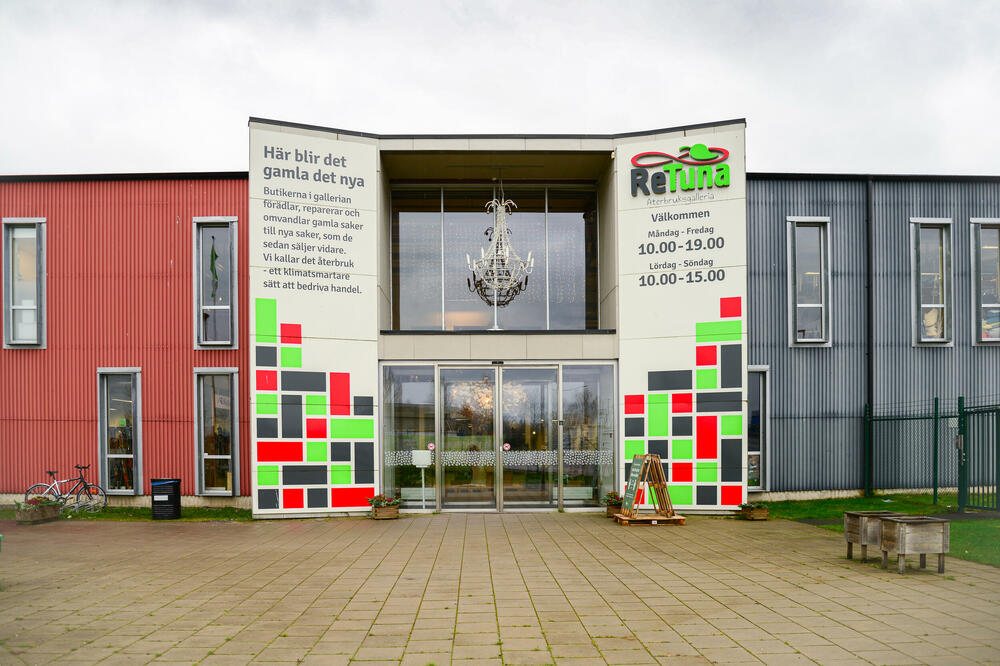
What it is
ReTuna Återbruksgalleria opened in Eskilstuna in 2015 and describes itself as the world’s first recycling mall. It sits next to the municipal recycling centre so disposal and reuse happen in the same trip.
Visitors can leave reusable furniture, clothes, electronics, toys and household goods at a receiving depot. Items are sorted, distributed to shops, repaired or transformed and sold again.
How it works
- Collection: reusable objects are separated from the waste stream at the adjacent recycling centre and ReTuna depot.
- First sort: staff from AMA, an Eskilstuna Municipality resource unit focused on activity, motivation and work, make an initial judgement about what can be reused.
- Second sort: shops select items they can repair, refine, convert or resell.
- Retail: reuse is presented through a familiar shopping-centre format instead of as a specialist waste service.
- Education: tours and public communication turn the mall into a demonstration of circular consumption.
Community / operating model
ReTuna links municipal waste infrastructure, employment activity and independent retail. That combination is what makes it more than a second-hand market.
According to ReTuna, the project has generated more than 50 jobs. Its municipal connection also gives the reuse system a reliable intake point: the stream of discarded goods already exists because the recycling centre exists.
What can be copied
- Place reuse before disposal in the physical journey of waste.
- Use an ordinary retail environment to make repaired and reused products feel normal rather than marginal.
- Connect circular infrastructure with employment and skills programmes.
- Let shops specialise while sharing one common intake system.
Yogawiser read
ReTuna’s smartest design decision may be spatial rather than technological: the place where you get rid of something and the place where someone else buys it are almost the same place.
Evidence / trade-offs
What makes this difficult to copy?
Reuse is labour before it is retail. Ethnographic research at ReTuna shows that second-hand goods become saleable through repeated sorting, cleaning, modifying, pricing and marketing—and that those valuation processes create coordination problems.
The mall therefore needs a steady intake of usable goods, people with repair and valuation skills, and customers willing to buy them. A collection point beside a shop is not enough by itself to create a functioning reuse economy.