What it is
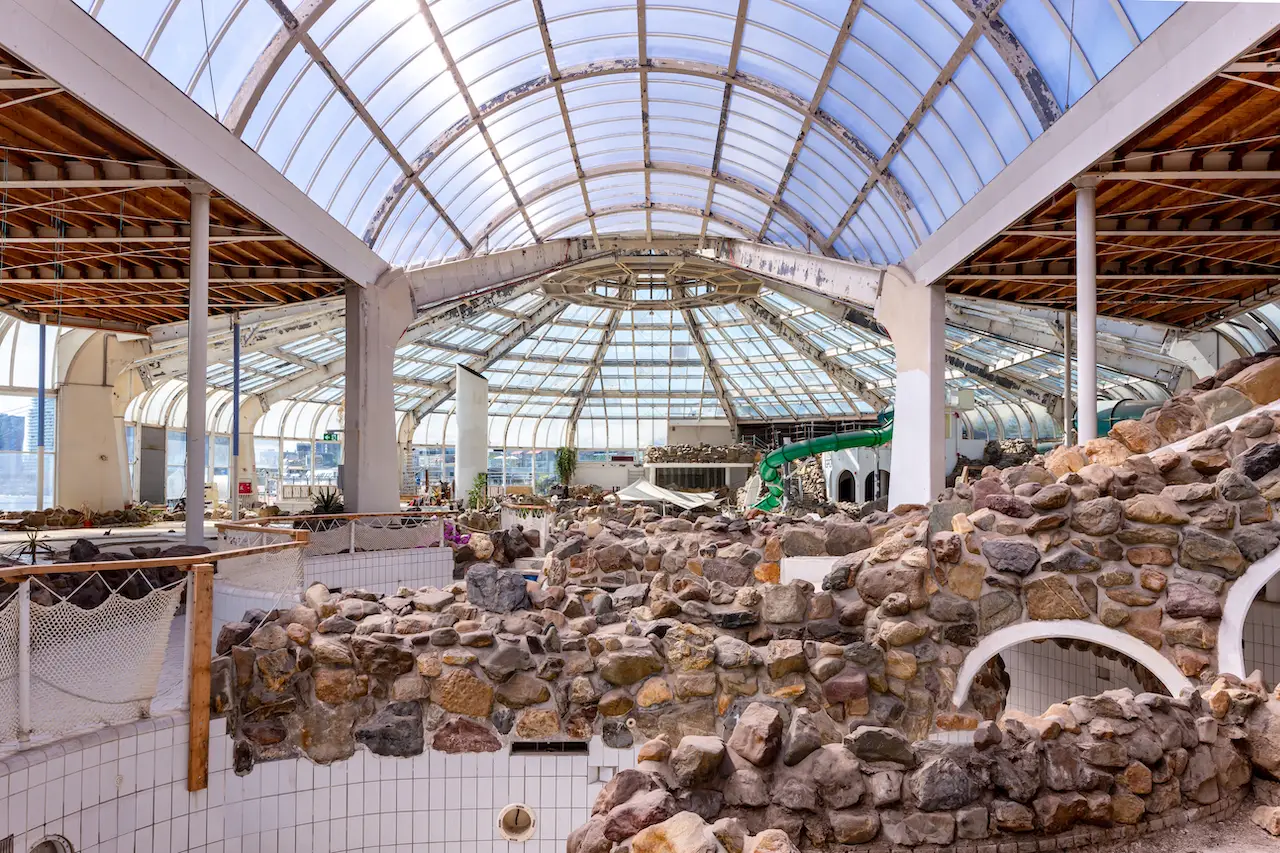
BlueCity has occupied Rotterdam’s former Tropicana swimming complex since 2015. Instead of demolishing the building, it became a 12,000 m² hub where circular entrepreneurs, researchers, companies, government and education work alongside one another.
Its stated aim is to accelerate the shift from a linear economy to a circular—and ultimately blue—economy in which the output of one process becomes an input for another.
How it works
- Shared place: more than 55 entrepreneurs, makers and researchers work from the repurposed building.
- Material loops: residual streams can become resources for other businesses; coffee grounds growing oyster mushrooms is one of its simplest examples.
- Biolab: the site supports experimentation in biodesign and materials made with living organisms.
- Programmes: start-up support, chain projects, hackathons and town halls move ideas toward pilots and businesses.
- Public interface: events and visits make circular entrepreneurship visible beyond resident companies.
Community / operating model
BlueCity’s community model is entrepreneurial rather than residential. Start-ups, researchers, established businesses, public bodies and educational institutions are deliberately mixed.
Its value comes from proximity: organisations can exchange knowledge, facilities, residual materials, introductions and customers without building every capability alone. Regular public and professional events extend the network beyond tenants.
What can be copied
- Put circular businesses close enough to trade by-products, knowledge and opportunities.
- Reuse a large existing building as transition infrastructure instead of waiting for a purpose-built innovation district.
- Combine workspace with programmes that help experiments become viable businesses.
- Give emerging materials access to labs, partners and public visibility in the same ecosystem.
Yogawiser read
BlueCity treats the circular economy less like a lifestyle category and more like industrial organisation. The building is essentially a matchmaking device for flows that would otherwise remain disconnected.
Evidence / trade-offs
What makes this difficult to copy?
A circular hub can make experimentation easier without solving the hardest part: scale. BlueCity itself describes regulation, limited investment and competition from cheaper linear models as persistent barriers for circular entrepreneurs.
The building is strongest as an ecosystem for prototyping, networking and early manufacturing. Material-heavy circular operations still need logistics, land and industrial capacity beyond a central innovation hub, so the BlueCity model should not be mistaken for the whole circular economy.