What it is
Kalundborg Symbiosis traces its collaboration back to 1972. The current organisation describes sixteen public and private partners working through an industrial symbiosis model in which a waste or surplus stream from one company becomes a resource for another.
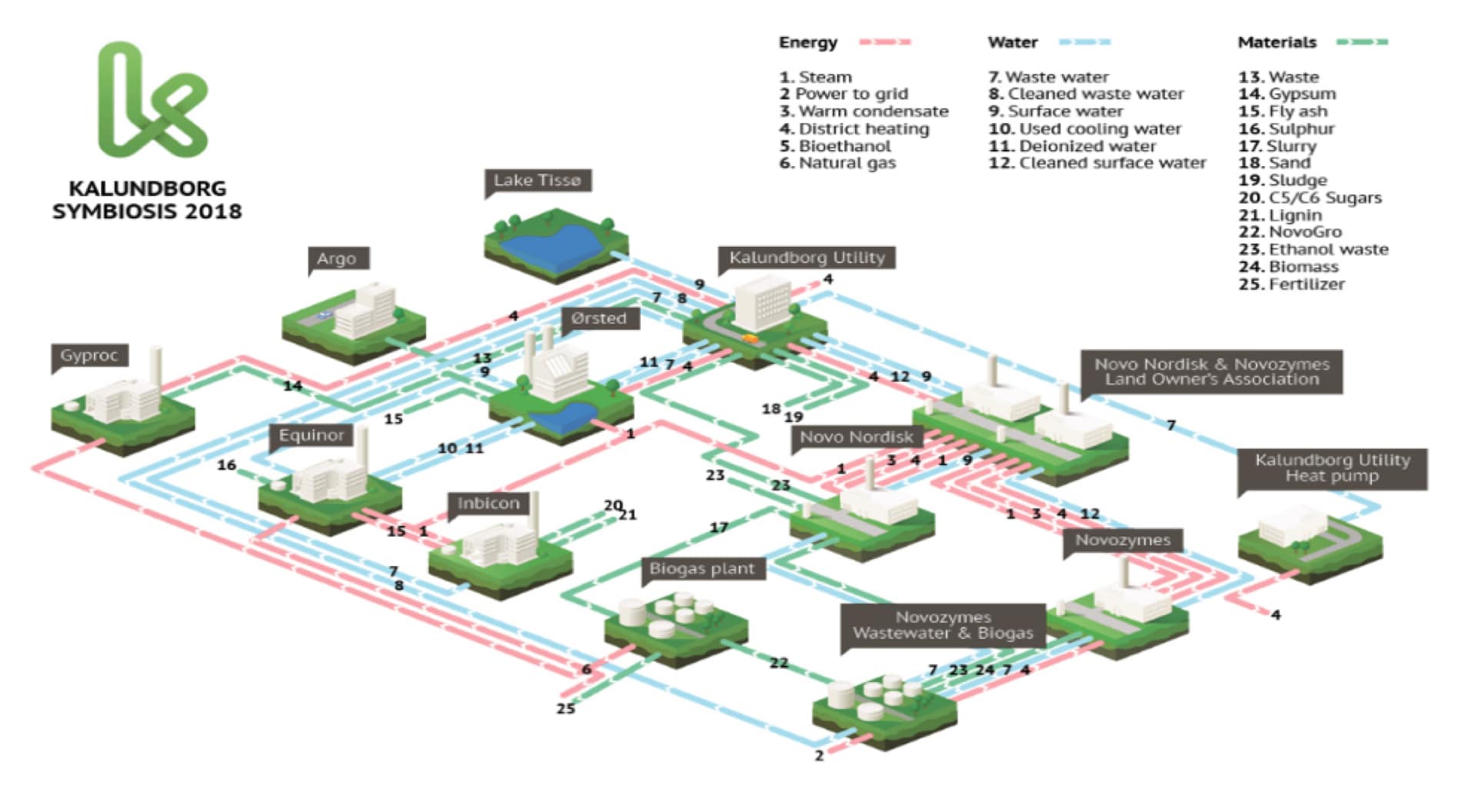
This is circular economy at a scale that is easy to romanticise and hard to build: the arrows in the diagram are not metaphors. They represent real exchanges of steam, water, heat, biomass, nutrients and other materials between industrial partners.
How it works
- Energy: steam, electricity, condensate, district heating, biomethane and hot water move between partners.
- Water: wastewater, treated wastewater, surface water, cooling water and condensate are exchanged and reused according to quality and need.
- Materials: sulphur, sludge, biomass, fertiliser inputs, yeast cream and multiple other residual streams move through the system.
- Contracts: the exchanges work because companies have commercial and operational reasons to cooperate, not because circularity is treated as charity.
- Learning: the partnership now positions Kalundborg as an international knowledge centre for industrial symbiosis.
Community / operating model
The unusual community here is industrial. Trust between companies becomes a form of infrastructure because long-lived exchanges require technical coordination, contracts, transparency and confidence that partners will still be there tomorrow.
Kalundborg’s 2035 strategy explicitly treats governance, shared ownership and collaboration as necessary conditions for scaling the model. The organisation is also trying to add new symbiosis solutions, including water-related exchanges, rather than treating the current network as finished.
What can be copied
- Map local surplus streams before designing a new circular product from scratch.
- Start with exchanges that create direct operational or financial value for both sides.
- Build a neutral coordinating layer that can identify matches between organisations that would not otherwise talk.
- Treat trust, contracts and shared infrastructure as part of circular design.
Yogawiser read
Circular economy diagrams usually look finished the moment the arrows are drawn. Kalundborg is interesting because the arrows have had to survive decades of maintenance, corporate change and negotiation.
Evidence / trade-offs
What makes this difficult to copy?
Kalundborg did not emerge because somebody drew a perfect circular diagram. Research reconstructing the network finds bilateral commercial exchanges to be the basic mechanism: a stream has to make business sense for the organisations on both sides.
New symbioses can require pipelines, treatment equipment and long commitments before trust is fully established. That creates a chicken-and-egg problem: the physical link needs investment, while the investment depends on confidence that the relationship will last.