What it is
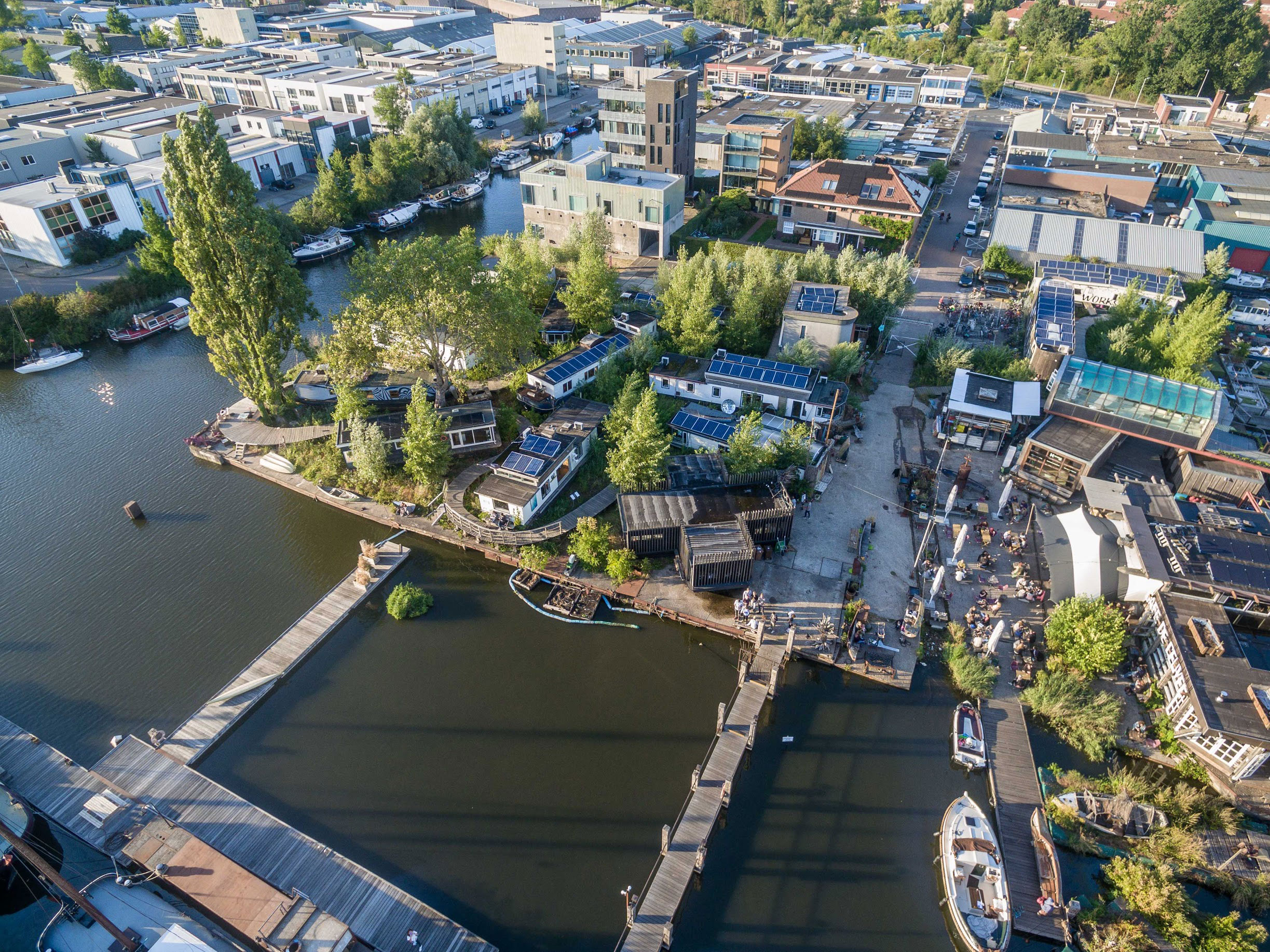
De Ceuvel began on heavily polluted former industrial land in Amsterdam-Noord. Old houseboats that would otherwise have been discarded were placed on land and converted into workspaces for creative and social enterprises.
Its real value is that many systems remain visible at human scale: the boardwalk, reused boats, planted remediation landscape, water treatment and energy experiments sit next to everyday work, food and cultural activity.
How it works
- Soil: a planted Purifying Park uses phytoremediation to absorb, stabilise or reduce pollutants in contaminated ground.
- Water: decentralised helophyte filters treat greywater; compost toilets were used where sewer installation was constrained by contamination.
- Energy: solar PV, heat pumps and heat-recovery ventilation reduce dependence on conventional energy.
- Materials: discarded houseboats and second-hand construction materials were upcycled into workspaces.
- Learning: infrastructure is deliberately exposed, toured and documented rather than hidden.
Community / operating model
De Ceuvel was built cooperatively and is jointly managed through Vereniging De Ceuvel, a mission-driven association. Its board is elected from and by members and works on a voluntary basis.
A General Members’ Meeting is held four times a year; the board handles ongoing management, tenant relationships and external representation. The governance structure is therefore part of the experiment, not an administrative footnote.
What can be copied
- Make infrastructure legible so people can understand where water, energy, nutrients and materials move.
- Use temporary sites as test beds rather than waiting for permanent masterplans.
- Pair technical systems with governance that gives users responsibility for the place.
- Treat contaminated land as a learning landscape, not only as a remediation problem.
Yogawiser read
The interesting part is not that De Ceuvel contains many sustainable technologies. It is that those technologies are made social. A toilet, a wetland filter, a reused boat and a members’ meeting become parts of the same urban metabolism.
Evidence / trade-offs
What makes this difficult to copy?
The phytoremediation story is uneven. Follow-up work found measurable reduction in PAH contamination, while heavy-metal extraction was far slower: after years of phytoextraction there was still no measurable reduction in soil heavy-metal concentrations.
De Ceuvel also depended on temporary land tenure and experimental regulatory space. The raised boardwalk, relocatable boats and low-cost systems make sense partly because the site was conceived as an interim use, not a permanent neighbourhood template.