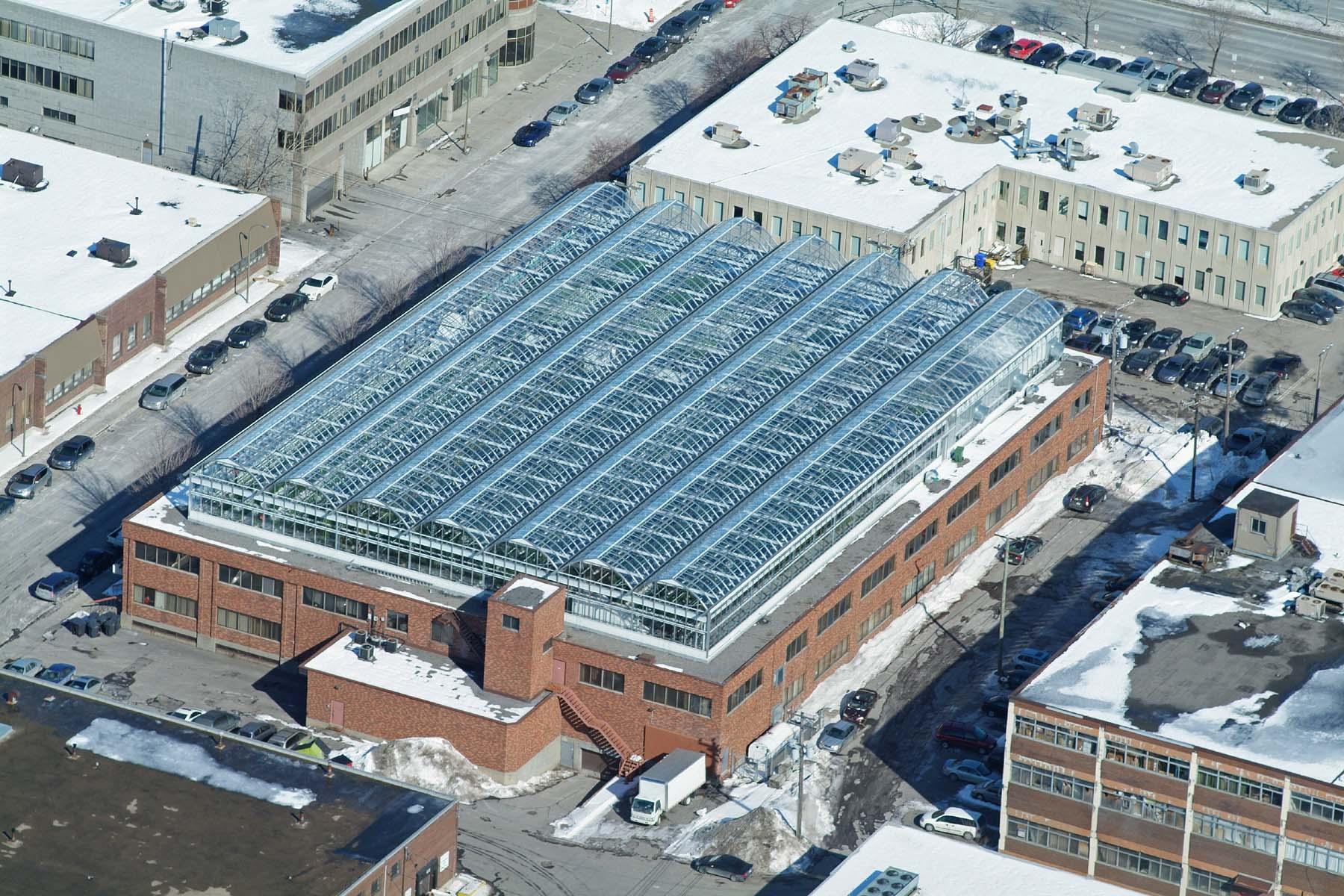
What it is
Lufa Farms opened what it describes as the world’s first commercial rooftop greenhouse in Montreal in 2011. It has since expanded into a network of urban farms and a food-distribution marketplace.
The model matters because the farm is not treated as a demonstration object: greenhouse production, online ordering, aggregation of partner products, packing and last-mile distribution are designed as one system.
How it works
- Land: greenhouse production uses rooftops that would otherwise be largely unproductive urban surfaces.
- Water: hydroponic growing and recirculating irrigation reduce water demand; some sites also capture rain and meltwater.
- Energy: rooftop greenhouses can benefit from heat rising from the building below and use curtains and glazing to reduce heating demand.
- Crop protection: the company emphasises biological controls rather than synthetic pesticides.
- Distribution: produce is sold through a digital marketplace, home delivery and a large neighbourhood pickup network.
Community / operating model
This is not a community-owned farm; its social infrastructure is the customer and distribution network. Lufa uses neighbourhood businesses and community locations as pickup points.
Its marketplace also aggregates products from local farms and food makers, allowing the logistics network to carry more than the rooftops themselves produce. A direct-giving programme works with nonprofits to provide food baskets to families.
What can be copied
- Do not isolate urban farming from distribution—the logistics model can matter as much as the greenhouse.
- Use underused building surfaces without consuming new land.
- Aggregate other local producers onto the same ordering and delivery infrastructure.
- Build pickup points into existing neighbourhood businesses instead of creating a new retail footprint everywhere.
Yogawiser read
Lufa is useful precisely because it is not a picturesque urban farm. It tests whether rooftop agriculture can survive contact with the boring parts of food systems: packing, subscriptions, routing, delivery and margins.
Evidence / trade-offs
What makes this difficult to copy?
Commercial rooftop greenhouses remain technically and financially demanding. Research using Lufa Farms and Gotham Greens as successful cases still identifies high upfront investment, structural and legal requirements, production complexity and distribution economics as major barriers.
A rooftop is not automatically the best place to grow every crop. The environmental case depends on what is grown, how the greenhouse is heated and lit, what building it sits on and which transport or storage systems it actually replaces.