What it is
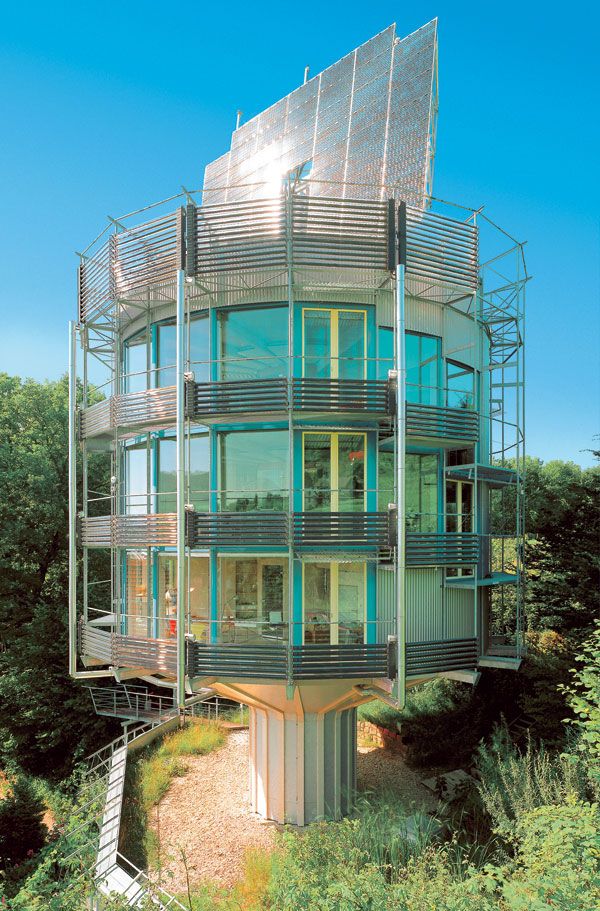
Rolf Disch completed the Freiburg Heliotrope in 1994 as his own residence and a prototype for solar architecture. Its cylindrical three-storey body rotates around a central column.
The concept is more active than a conventional passive-solar house: the glazed side can track useful solar gain, while in hot conditions the building can turn its heavily insulated rear toward the sun. A separate photovoltaic ‘solar sail’ on the roof rotates independently.
How it works
- Orientation: the entire occupied body rotates so exposure can change with sun and season.
- Electricity: a large roof-mounted photovoltaic array tracks the sun independently of the house.
- Heat: the envelope uses solar gain, insulation and additional solar-thermal / geothermal systems.
- Prototype: the Freiburg house was built as an occupied residence, allowing the concept to be tested as daily architecture rather than a moving sculpture.
- Transfer: the project became an early demonstrator for the wider PlusEnergy ideas later developed by Rolf Disch.
Community / operating model
The Heliotrope is not a community project; its value lies in prototyping. It belongs in Yogawiser because it turns a normally fixed architectural variable—orientation—into an operating system.
Its relationship to Freiburg is also useful: the prototype sits close to Vauban and the Solar Settlement, where PlusEnergy ideas were later applied at a larger and less mechanically unusual scale.
What can be copied
- Prototype ambitious energy ideas at building scale before trying to standardise them.
- Treat orientation and envelope behaviour as active design variables.
- Separate the memorable experiment from the transferable principle: buildings do not all need to rotate to learn from solar responsiveness.
- Measure innovation against long-term energy production and operation, not only visual novelty.
Yogawiser read
The Heliotrope is almost comically literal: a house behaves like a sunflower. That literalness is useful—it makes the invisible problem of orientation impossible to ignore.
Evidence / trade-offs
What makes this difficult to copy?
The rotating house is the memorable experiment, not the part that became ordinary construction. Rolf Disch's own visitor material explicitly frames the nearby Solar Settlement as the step from an experimental building toward marketable ecological neighbourhood construction.
Copying the rotation mechanism would miss the larger lesson. The more transferable principles are solar orientation, low demand and net-positive energy production—ideas that can survive even when the building itself stops moving.