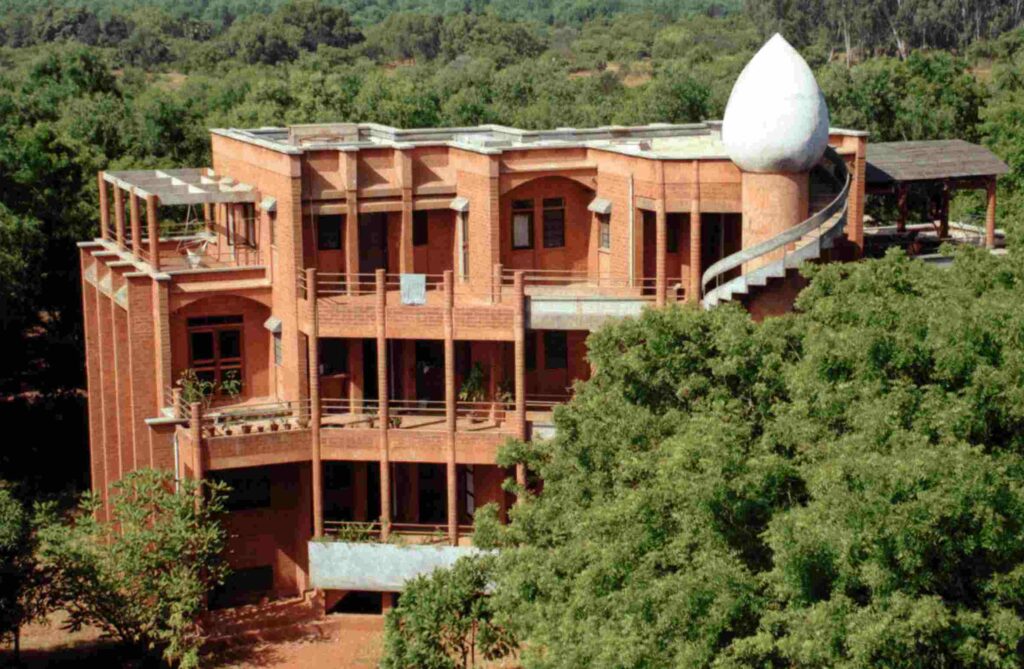
What it is
The Auroville Earth Institute was founded in 1989 and describes its work through three verbs: training, research and construction. Its best-known field is compressed stabilised earth blocks, alongside arches, vaults, domes, rammed earth and related systems.
The important move is institutional. Earthen construction is not presented only as vernacular inspiration; the institute develops equipment, structural methods, production systems, training courses, testing and documentation so the material can enter contemporary practice.
How it works
- Material research: local soils are analysed and stabilised to create repeatable earth-building systems.
- CSEB: compressed stabilised earth blocks are produced with controlled mixes and dedicated presses rather than informal hand shaping alone.
- Structure: the institute develops arches, vaults, domes and disaster-resistant systems using earth-based components.
- Training: on-campus and online programmes teach production, masonry, design and structural principles.
- Transfer: the institute reports work across dozens of countries, making dissemination part of the technical project.
Community / operating model
The community here is a learning network: trainees, builders, architects, engineers and institutions who can carry a material system somewhere else.
Current 2026 training schedules include CSEB design and intensive courses, arches-vaults-domes programmes and ferrocement, showing that the institute operates as an active school rather than a historical archive.
The model matters because low-carbon materials do not scale through inspiration alone. They need people who know how to test, specify, produce and build with them.
What can be copied
- Invest in training infrastructure at the same time as material innovation.
- Turn local material knowledge into testable methods without stripping away its climatic logic.
- Design tools and production processes that make alternative materials easier to repeat consistently.
- Measure success partly by how well knowledge travels beyond the original site.
Yogawiser read
The radical thing is not building with earth. Humans have done that forever. The radical thing is treating earth as a modern technical discipline serious enough to teach, test and export.
Evidence / trade-offs
What makes this difficult to copy?
Earth is not a specification by itself. The Institute stresses that not every soil is suitable for CSEB and that block quality depends on soil composition, stabiliser, compression, curing and manufacturing. Its Auroville blocks typically use about 5% cement and still absorb water.
The carbon advantage is substantial compared with fired brick, but it is not impact-free and it is highly process-dependent. Copying the material requires local soil testing, trained production and climate-appropriate detailing—not simply replacing concrete blocks with whatever earth is nearby.