What it is
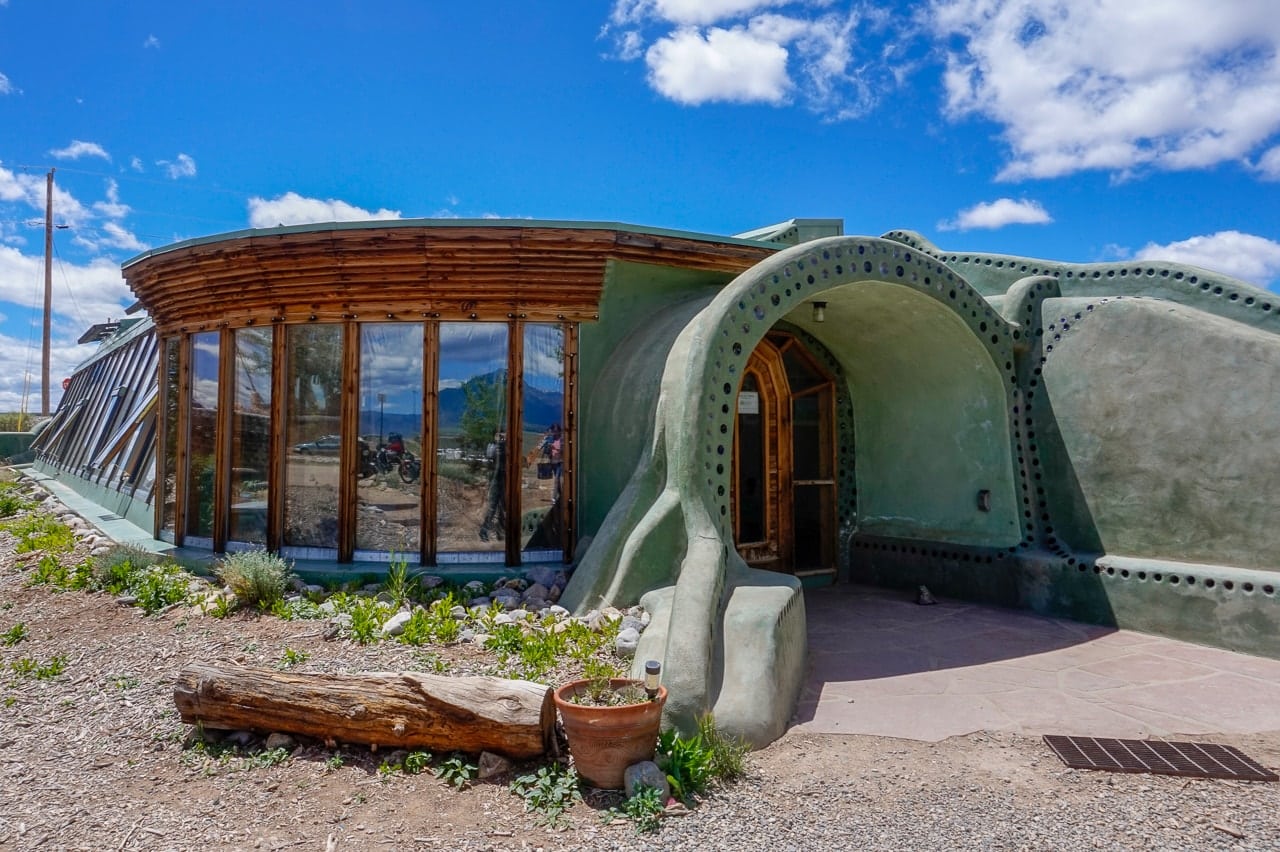
The Earthship Visitor Center in northern New Mexico is not a model room detached from use. It is a functioning Earthship built to make the building type’s systems visible to visitors.
Earthship Biotecture describes the core approach through six principles: natural and repurposed materials, passive heating and cooling, solar and wind electricity, food production, water harvesting and contained sewage treatment.
How it works
- Materials: rammed-earth tires, cans, bottles and other natural or repurposed materials form part of the building system.
- Thermal comfort: passive solar design, thermal mass and earth coupling reduce dependence on conventional heating and cooling.
- Water: rain and snowmelt are harvested, stored, filtered and reused through multiple household functions.
- Wastewater: greywater and blackwater are treated within contained biological systems rather than immediately exported to a distant sewer plant.
- Power + food: solar and wind systems provide electricity, while attached greenhouse space supports food production.
Community / operating model
The Visitor Center is primarily an educational institution rather than a resident-governed community. Its wider social infrastructure comes from the Earthship Academy, field studies, rentals, tours and an international network of builders and owners.
The tour route is unusually useful because visitors can physically encounter the greenhouse, roof catchment, water-organising and power-organising systems rather than seeing only finished interiors.
What can be copied
- Design utilities as connected loops instead of six unrelated products purchased from six different industries.
- Make maintenance and flows visible enough that occupants can understand what their building is doing.
- Use demonstration buildings that actually operate, not only exhibition mock-ups.
- Treat water security, food, thermal comfort and energy as one resilience problem.
Yogawiser read
Earthships are most useful as systems thinking at the scale of a house. Whether every component transfers to every climate is a separate question; the provocation is that the household can understand its own metabolism.
Evidence / trade-offs
What makes this difficult to copy?
Earthship performance is real but not uniform. Monitoring in Taos found some Global Model examples remained remarkably stable without active heating, while others dropped slightly below comfort limits before sunrise or required ventilation to avoid daytime overheating.
The architecture is strongly coupled to climate, solar exposure, thermal mass, occupant operation and water availability. The transferable idea is integrated household metabolism; the exact Taos geometry and systems should be recalibrated rather than copied unchanged.