What it is
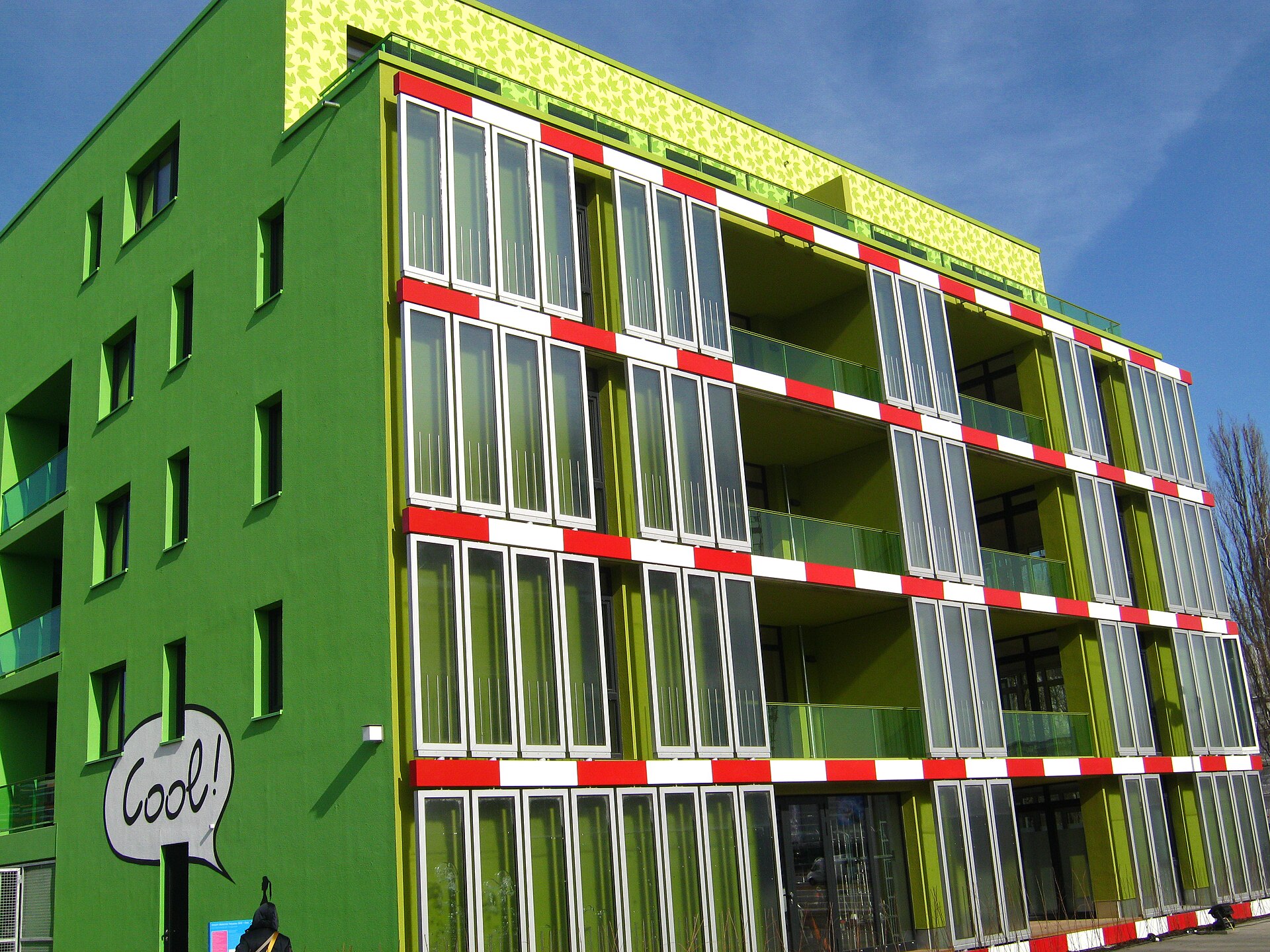
BIQ House was built in Hamburg for the 2013 International Building Exhibition as a four-storey residential apartment block with a bio-responsive algae façade.
Arup developed the SolarLeaf system with project partners as flat-panel photobioreactors integrated into the façade. Air bubbles help circulate the culture and improve access to carbon dioxide and light while also helping clean the panels internally.
How it works
- Growth: microalgae inside transparent façade panels use light and carbon dioxide to produce biomass.
- Heat: the liquid circulating through the panels also collects solar thermal energy.
- Shading: algae density changes with growth, so the façade’s biological activity also alters solar screening.
- Harvest: biomass can be removed from the façade and treated as an energy or material resource.
- Occupied prototype: the system operates on apartments, forcing experimental technology to coexist with real building use.
Community / operating model
BIQ House is primarily a technology prototype rather than a resident-led social experiment. Its social relevance comes from where the experiment was placed: around ordinary apartments rather than inside a sealed laboratory.
That distinction matters because façade systems eventually have to survive maintenance, comfort requirements, ownership structures and everyday operation—not just perform during a demonstration.
What can be copied
- Combine multiple functions in one component when the extra maintenance is justified.
- Test new environmental technologies in occupied buildings early enough to expose operational problems.
- Treat façades as potential productive surfaces, not only weather barriers.
- Document maintenance and lifecycle behaviour as carefully as peak technical performance.
Yogawiser read
The façade stops being a static boundary and behaves more like a thin farm wrapped around apartments—growing, shading and participating in the building’s energy system.
Evidence / trade-offs
What makes this difficult to copy?
BIQ proved a full-scale bio-reactive façade can operate, but the evidence base remains unusually small. Reviews still describe algae façades as an emerging technology with gaps in long-term guidance, while engineering research identifies climatic, biological, structural and operational damage risks.
Economics are scale-sensitive too: later research argues that bioenergy façades become more viable as façade area increases and suggests areas below roughly 700 m² are less attractive. A working prototype is therefore not the same thing as an easy façade specification.