What it is
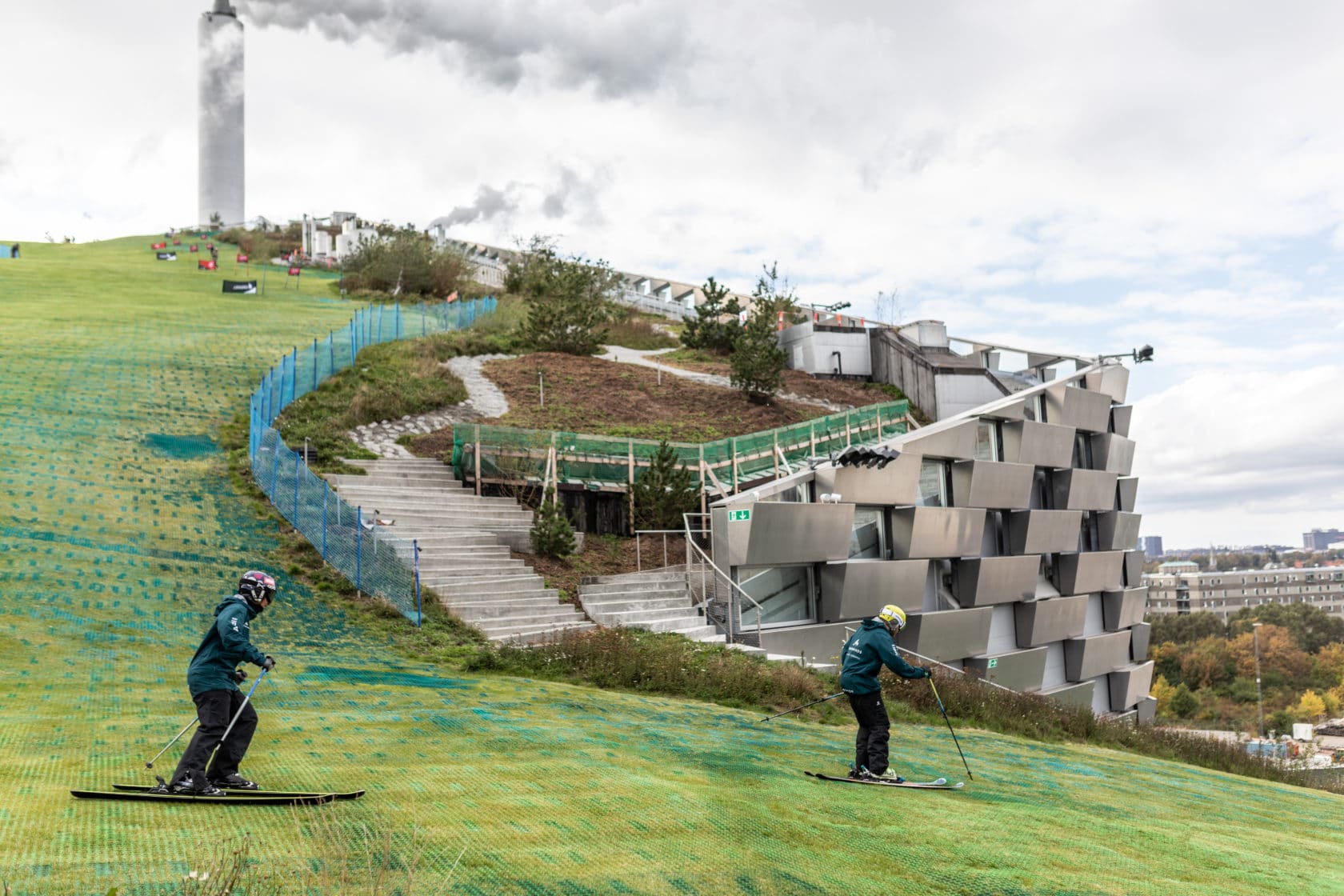
CopenHill, also known as Amager Bakke, turns a piece of heavy municipal infrastructure into a place people visit for reasons that have nothing to do with waste treatment. BIG designed the plant so its sloping roof could become a year-round recreational landscape.
The facility officially opened in 2019. Today the roof functions as a publicly accessible urban mountain with hiking and running routes, cafés and views over Copenhagen, while skiing, climbing and organised activities operate alongside them.
How it works
- Waste below: the underlying plant converts municipal waste into electricity and district heating.
- Public space above: the geometry required by industrial machinery becomes the topography for skiing, hiking and running.
- Visibility: the elevator is positioned so visitors can glimpse the plant’s internal workings rather than treating the utility as an invisible box.
- Landscape: planted roof areas turn the industrial envelope into usable urban terrain.
- Programming: sport, events, food and guided tours keep the infrastructure socially active after the architecture itself stops being new.
Community / operating model
CopenHill is not community-owned in the ecovillage sense. Its social model is public access: CopenHill A/S operates the recreational layer, while the power plant below remains utility infrastructure.
The official site describes the hill as a place for families, students, runners, skiers and local communities to be active together. A running community, events and recurring freestyle sessions add regular social use to what could otherwise have been a one-off architectural attraction.
What can be copied
- Layer public value onto infrastructure that already has to exist.
- Design industrial buildings so people can understand, approach and use them rather than only viewing them from behind a fence.
- Use roofs and façades as civic territory instead of leftover surfaces.
- Give a sustainability project reasons to be loved that are not sustainability itself.
Yogawiser read
The interesting question is not whether a ski slope makes an incinerator sustainable. It is whether infrastructure has to be socially dead. CopenHill’s answer is very literal: you can climb it.
Evidence / trade-offs
What makes this difficult to copy?
The roof is public infrastructure; the plant below is still an incinerator. Life-cycle research on Amager Bakke finds that fossil carbon in residual waste makes the plant a net greenhouse-gas burden without carbon capture, and that the climate benefit of recovered energy weakens as the surrounding energy system gets cleaner.
That makes the project useful for thinking about public access to infrastructure, but not as evidence that waste incineration itself is circular. The replicable lesson is the civic layer; the waste-treatment layer has to be judged separately against reduction, reuse and recycling.