
Apple Park
A Living Campus


Apple Park is not an office complex. It is a designed ecosystem.
Conceived as Steve Jobs’ final vision, the campus was built around a simple principle. People should work inside nature, not next to it. The result is a self-regulating landscape where architecture, climate, energy and human rhythm operate as a single system.
Site Philosophy
Apple Park sits on 175 acres of former industrial land in Cupertino.
Instead of dominating the terrain, the campus dissolves into it. The building behaves less like an object and more like a geological form placed gently onto the land.
The circular form creates:
-
A protected microclimate
-
A central valley-like garden
-
A continuous horizon line
Climate System
Apple Park was engineered as a mixed-mode climate building operating primarily on passive environmental control strategies.
Passive Climate Design
-
Operable facade panels enabling cross-ventilation
-
Stack-effect driven airflow through vertical atriums
-
Night-time thermal flushing
-
Deep floor plates with controlled solar penetration
-
Shading geometry integrated into facade curvature
The building maintains internal comfort conditions between 20–26°C for approximately 70–75% of the year without mechanical cooling.
Active Climate Systems
-
Radiant floor and ceiling cooling systems
-
High-efficiency heat pump network
-
Central chilled water plant
-
Demand-controlled ventilation (DCV)
-
CO₂-based occupancy sensing
The system operates with real-time climate modeling integrated into the Building Management System (BMS).
Energy System
The campus runs on 100% renewable energy. Apple Park is designed as a high-performance energy campus with on-site generation and load balancing capabilities.
The energy system consists of:
-
17 MW rooftop photovoltaic array covering over 65,000 m²
-
On-site lithium-ion battery storage for peak shaving and grid stabilization
-
Microgrid architecture enabling island-mode operation
-
Grid-interactive demand management systems
-
High-efficiency building envelope reducing cooling loads
The photovoltaic system generates approximately 75% of the campus’ annual electricity demand during peak production periods.
Remaining energy demand is offset through certified renewable energy procurement.
On-Site Renewable Energy Infrastructure
-
17 MW rooftop photovoltaic array
-
Lithium-ion battery energy storage system
-
Campus-scale microgrid
-
Fully electrified building systems
-
No on-site fossil fuel combustion
The campus operates on a net-zero operational carbon model.
Energy Optimization
-
Real-time load balancing
-
Automated peak shaving
-
Demand-response integration
-
Thermal load shifting
-
Predictive energy modeling


Apple CEO Tim Cook speaks about renewable energy during a media event at Apple's new headquarters in Cupertino, Calif., on Sept. 12, 2017.
Josh Edelson/AFP/Getty Images
Passive Load Reduction Strategy
Energy demand is minimized before generation is scaled.
This is achieved through:
-
High-performance triple-glazed facade systems
-
Low-emissivity coatings
-
Solar heat gain control
-
Natural ventilation reducing HVAC load by up to 60% annually
-
Thermal mass utilization within the concrete core
The building is optimized for low Energy Use Intensity (EUI) through integrated architectural and mechanical design.

Glass canopy system regulating daylight and glare on every floor — Dan Winters / WIRED

Sectional facade rendering of Apple Park — RIBA Journal
For Apple Park’s curved glass façade, sedak developed a custom cold-bending and lamination process. Each panel was individually shaped after tempering, requiring a newly engineered furnace capable of heating and forming multiple curved panels simultaneously.
Smart Grid Integration
Apple Park operates as a grid-aware campus. This allows continuous optimization of energy flows across the campus.
-
Real-time load monitoring
-
Automated peak load shifting
-
Energy storage dispatch during demand spikes
-
Building Management System (BMS) integration
-
Weather-responsive load forecasting
Water System
#Closed-Loop Hydrology Infrastructure
Apple Park was designed as a water-resilient campus operating with an internal non-potable water network.
Water Supply Strategy
-
100% recycled non-potable water for irrigation and cooling towers
-
On-site greywater treatment plant
-
Rainwater harvesting and storage basins
-
Smart irrigation controlled by soil moisture sensors
The system reduces potable water demand by over 60% annually.
Landscape Hydrology
-
Bioswales
-
Permeable paving
-
Subsurface retention systems
-
Flood buffering basins
Stormwater is retained, filtered, and reintegrated into the site hydrology.
Waste System
Apple Park was designed as a zero-waste campus operating under a closed-loop material management model. Waste is treated as a recoverable resource stream, not a disposal output. The objective is landfill elimination.
Zero-Waste Operational Strategy
Apple Park operates under a Zero Waste Certification framework. All waste flows are mapped and monitored at building and department level.
Core targets:
-
90%+ landfill diversion
-
Full material traceability
-
Closed-loop supplier integration
-
Elimination of single-use plastics
Source Separation Infrastructure
Waste is separated at origin into defined resource channels:
-
Organic waste
-
Paper and cardboard
-
Glass
-
Metals
-
Plastics
-
Electronic waste
-
Packaging materials
Infrastructure includes:
-
Centralized waste hubs on every floor
-
Color-coded collection architecture
-
Back-of-house logistics corridors
-
On-site pre-sorting facilities
Contamination is minimized through behavioral design and signage.
Organic Waste System
All food waste from Apple Park kitchens and cafes is diverted from landfill. Food waste becomes soil input.
Processing includes:
-
Industrial-scale composting
-
Anaerobic digestion partnerships
-
Soil regeneration programs
Outputs are reintegrated into:
-
Campus landscaping
-
Orchard systems
-
Local regenerative agriculture
Packaging & Supply Chain Integration
Packaging is treated as part of the product lifecycle. Apple requires all suppliers serving Apple Park to comply with:
-
Recyclable or compostable packaging
-
Minimal material use
-
Elimination of mixed-material composites
-
Returnable logistics containers
Construction & Fit-Out Waste
Interior systems are modular and demountable to enable future reuse. During construction and interior fit-out:
-
Over 90% of construction waste was diverted from landfill
-
Materials were sorted on-site
-
Concrete, steel, glass and aluminum were recycled
-
Timber was repurposed
Digital Waste Monitoring
Waste performance is reported alongside energy and water metrics. Apple Park uses digital tracking systems to monitor:
-
Waste volumes by material type
-
Recovery rates
-
Contamination levels
-
Vendor compliance
-
Lifecycle material impact
Materials
&Structure
Low-Carbon Construction Strategy
-
Post-tensioned concrete ring structure
-
High thermal mass core
-
Recycled aluminum facade system
-
Triple-glazed curved glass panels
-
Low-VOC interior materials
Structural Efficiency
-
Seismic base isolation
-
Column-free floor plates
-
Long-span post-tensioned slabs
-
Integrated services distribution
Material selection prioritized:
-
Durability
-
Low embodied carbon
-
Long lifecycle performance
Landscape Ecology
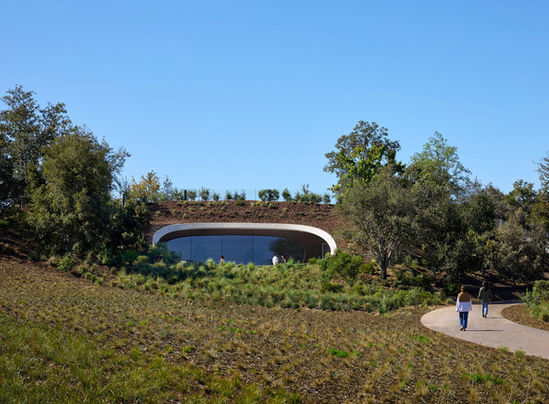
#Native Habitat Restoration
-
9,000+ native drought-tolerant trees
-
Oak woodland restoration
-
Pollinator corridors
-
Seasonal meadow systems
-
Orchard agriculture zones
The landscape reflects pre-industrial California ecology
and functions as a biodiversity corridor.
Pollinator Corridors
Pollinator corridors are continuous landscape systems designed to support the movement, feeding, and reproduction of pollinating species across fragmented environments. They function as biological infrastructure. Rather than isolated green spaces, pollinator corridors create connected habitat networks that allow bees, butterflies, birds, and other pollinators to migrate, forage, and maintain genetic diversity.
Why Pollinator Corridors Are Needed?
Urbanization and industrial agriculture have fragmented natural habitats into isolated patches. This fragmentation leads to:
-
Decline in pollinator populations
-
Reduced crop yields
-
Loss of plant genetic diversity
-
Ecosystem instability
More than 75% of global food crops depend partially on animal pollination. Without connected habitats, pollinators cannot survive at scale.
Mobility
& Human Flow
Low-Carbon Transportation System
-
Car-free interior zones
-
2-mile pedestrian loop
-
Bicycle-first circulation
-
Subterranean logistics network
-
Autonomous shuttle integration
Human Performance Design
-
Daylight-optimized circulation
-
Outdoor working zones
-
Walking meeting routes
-
Circadian lighting integration
-
Acoustic comfort zoning
The campus is engineered for cognitive performance and physiological well-being.


